RIAs drive active ETF adoption
Exchange-traded funds (ETFs) are increasingly becoming the dominant investment structure, as passive ETFs account for the largest portion of monthly flows among registered investment vehicles. Tax efficiency and lower fees have raised their profile among intermediary advisors trying to deliver the most value to clients and direct retail investors prioritizing cost. Registered investment advisors (RIAs) have led the charge for intermediary ETF adoption. They not only prefer the vehicle by a wide margin compared to other channels, but this has directly translated to assets, with RIAs becoming the lead source of active ETF adoption.
ETFs lead across channels
ISS MI’s Advisor Pulse series has captured a strong and growing preference among advisors for ETFs. The September 2024 edition on vehicle preferences and portfolio construction asked advisors which vehicle they would choose if the same strategy (from one of their preferred asset managers) were available as an open-end mutual fund, separately managed account (SMA), or ETF. Advisors strongly preferred ETFs, with 60% of advisors choosing the vehicle. When asked about their chief reasons for employing passive ETFs, low fees led strongly; 85% of advisors listed cost as one of their top three reasons, followed by 60% who specified tax efficiency. Both elements help advisors deliver value to clients without having to cut their fees.
ETFs were either the most popular vehicle or were tied for the most popular across intermediary channels in the 2024 survey. That figure, however, soars among RIAs; 81% of advisors in the channel stated that ETFs were their preferred vehicle. While advisor preferences for ETFs have increased over time, this is primarily the result of other channels gradually catching up to the wide lead seen within the RIA channel. RIA preferences have stayed relatively consistent over time; 80% of advisors in the channel were most interested in ETFs when asked in 2021.
ETF assets surge among RIAs
That preference has directly translated to assets held in ETFs. Data revealed in 13F filings, collected by ISS MI MarketPro, demonstrate that RIAs have a commanding position in ETFs. (These figures include assets from dually registered RIA firms, which will feature holdings from large firms that operate in the wirehouses and broker-dealer channels, such as Morgan Stanley and LPL Financial.)
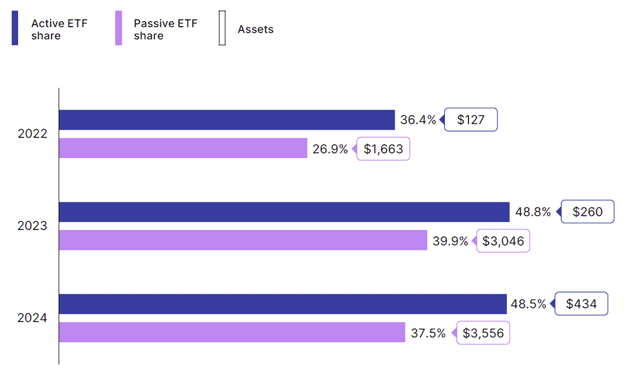
This data revealed nearly $4.0 trillion in ETF assets held by RIAs as of year-end 2024, representing an impressive 38.5% of total ETF assets. RIAs have been even more enthusiastic adopters of active ETFs. The $433.8 billion held by RIAs represented 48.5% of total active ETF assets. Figure 1 displays the share that RIAs compose of the active and passive ETF markets as well as total assets held by RIAs.
Figure 1: RIAs Account for The Dominant Portion of Active ETF Assets
Share of ETF assets held by RIAs and assets in billions of U.S. dollars, 2022 – 2024
As with passive ETFs, low fees and tax efficiency have stood out as key drivers of ETF adoption; however, a sizable demand for active management exists within intermediary channels. In one of last year’s Adviser Pulse surveys, 57% of advisors cited low fees as one of their top three reasons for adopting active ETFs, followed by 54% who referenced tax efficiency. Still, a respectable 44% chose active management.
The full report is available to subscribers on the MarketSage research portal. For more information about this report or any of ISS MI’s research offerings, please contact us.

By: Alan Hess, Vice President, U.S. Fund Research, ISS Market Intelligence