

Advisors are leading the charge in active ETF adoption
The investment industry is undergoing a structural transformation, and exchange traded funds (ETFs) have played a starring role. ETFs accounted for 35% of long-term fund assets under management (AUM) in May 2025, totaling nearly $11 trillion. Whereas ETF growth initially went hand-in-hand with greater adoption of passively managed funds, active ETFs are increasingly moving to center stage too.
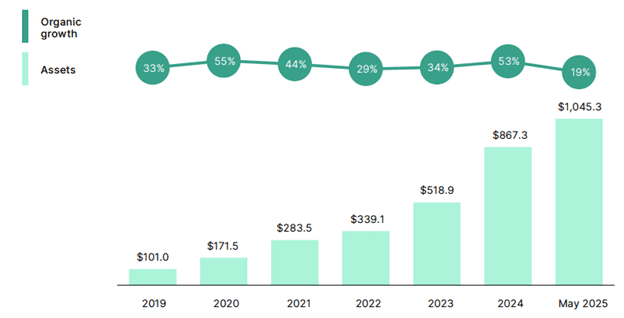
While the first active ETF debuted in 2008, the past few years have seen a dramatic increase in adoption. According to ISS Market Intelligence, active ETF assets have grown tenfold since 2019, reaching over $1 trillion by May 2025. This surge is not just a headline; it’s a signal of deeper changes in advisor vehicle preferences and product strategy.
The growth of active ETFs has been driven by both conversions from mutual funds and robust inflows (see Figure 1). From January 2020 through May 2025, net flows into active ETFs totaled $767 billion, growing at an average annualized rate of 48%. Advisors are leading the charge: in a March 2025 ISS MI survey, 62% of advisors said they plan to increase their clients’ exposure to active ETFs over the next 12 months, more than any other vehicle.
Figure 1: Active ETFs cross $1 trillion amid sales surge
Assets in billions of U.S. dollars, December 2019 – May 2025
Source: ISS MI MarketPulse powered by Simfund.
Note: Excludes money market funds and funds of funds. Organic growth is flows as a percentage of prior period assets.
Why are advisors so enthusiastic for active ETFs?
Advisors are drawn to unique value proposition of active ETFs. They combine the benefits of active management—such as the potential for outperformance and strategic flexibility—with the structural advantages of ETFs, including tax efficiency, lower fees, and intraday liquidity. In a 2024 survey conducted by ISS MI, 57% of advisors cited low fees as one of their top three reasons for adopting active ETFs, followed by 54% who referenced tax efficiency. Still, a respectable 44% chose active management, demonstrating a sizeable hunger for funds that seek to beat their benchmarks.
Significant opportunities lay ahead
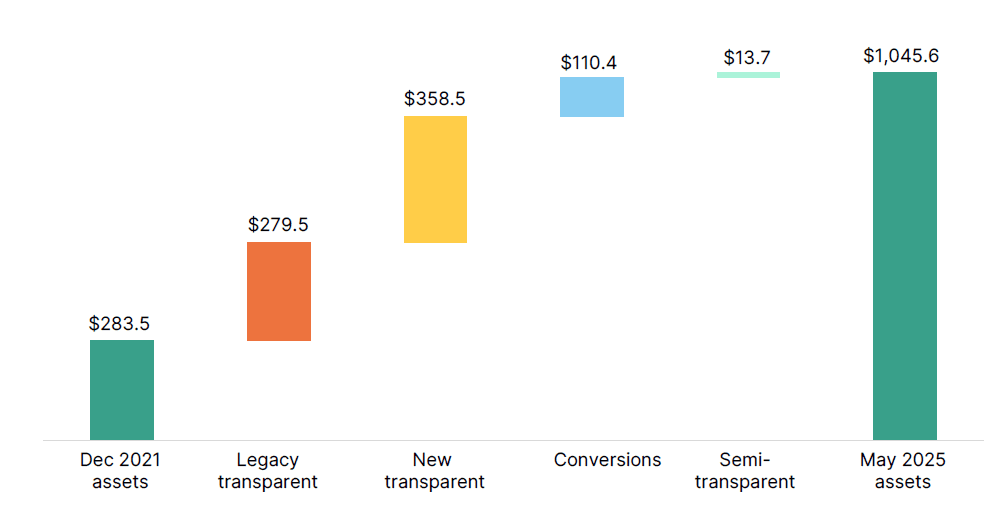
For asset managers, the opportunity is significant. While most new active ETFs struggle to reach scale, those that do often become major contributors to growth. And they do so with surprising speed. Historically, funds need to establish a multi-year track record before attracting significant assets, but nearly half of the active ETF AUM gains since 2021 came from ETFs launched in 2022 or later, as seen in Figure 2. This suggests that with the right combination of brand strength, product design, and distribution strategy, new entrants can thrive in this space.
Figure 2: Newer offerings, conversions driving recent active ETF boom
Components of asset growth in active ETFs, assets in billions of U.S. dollars, December 2021 – May 2025
Source: ISS MI Market Pulse powered by Simfund
Note: “Legacy transparent” refers to funds launched in or before 2021 and “New transparent” includes funds launched in or after 2022.
The product innovation engine is humming. In 2024, active ETFs accounted for a record number of new fund launches and the pace has continued into 2025. Managers are using ETFs to bring institutional strategies to retail investors, offer differentiated exposures, and even wrap complex strategies—like options overlays and structured outcomes—into accessible formats. Firms like JPMorgan, Capital Group, and Janus Henderson have led the way, demonstrating that active ETFs can be both innovative and scalable.
Moreover, the regulatory environment may soon provide an additional tailwind. The expiration of Vanguard’s ETF share class patent in 2023 opened the door for more than 50 asset managers to request SEC approval for dual mutual fund/ETF share classes. If approved, this change could dramatically expand the active ETF product shelf and lower operational barriers for managers looking to enter the space.
The bottom line? Active ETFs may no longer be a “nice to have”; they are increasingly a strategic imperative. They offer a rare combination of growth potential, advisor demand, and operational efficiency. For firms willing to invest in thoughtful product development and distribution, the rewards could be substantial.
The Active ETFs and the Expanding Product Shelf report is your guide to where the industry stands today, where it’s headed. Download your copy to explore the data, insights, and strategic implications in detail.