

What will define asset management over the next five years? ISS Market Intelligence’s latest State of the Market report reveals six trends that will reshape strategies from 2026 to 2030. This year, the report debuts in a three-part format, available exclusively to U.S.-based subscribers via the MarketSage platform.
Since its launch in 2005, the State of the Market has been a trusted guide for asset managers, providing deep insights into industry evolution: from the rise of fee-based advisory models to the proliferation of ETFs, SMAs, and CITs.
Christopher Davis, author of the report, sat down with Asset TV to dive into key insights. Watch the full segment below and read on for highlights.
Planning for a Slower Growth Environment
The report underscores a major shift: moderate growth ahead. After years of U.S. equity dominance, forecasts point to a more balanced performance across asset classes, including international equities and fixed income. For managers, this means adapting to a reality where markets alone won’t drive asset growth and where revenue pressure will intensify. Strategic planning is essential to navigate this slower-growth environment.
Sales and Distribution Matter More Than Ever
With advisors driving product adoption and influencing investor decisions, distribution capabilities are now critical differentiators. Managers must strengthen advisor relationships, provide education on new solutions, and help advisors deliver value to clients in an era of rapid product innovation.
More Balanced Asset Class Growth Ahead
The next five years are expected to bring a broader mix of growth opportunities. International equities and fixed income, which underperformed in recent years, are poised for a rebound. Managers with expertise in these areas—or those with diversified portfolios—are well-positioned to capture new growth.
ETFs Dominate Sales; Active ETFs Surge Amid Product Innovation
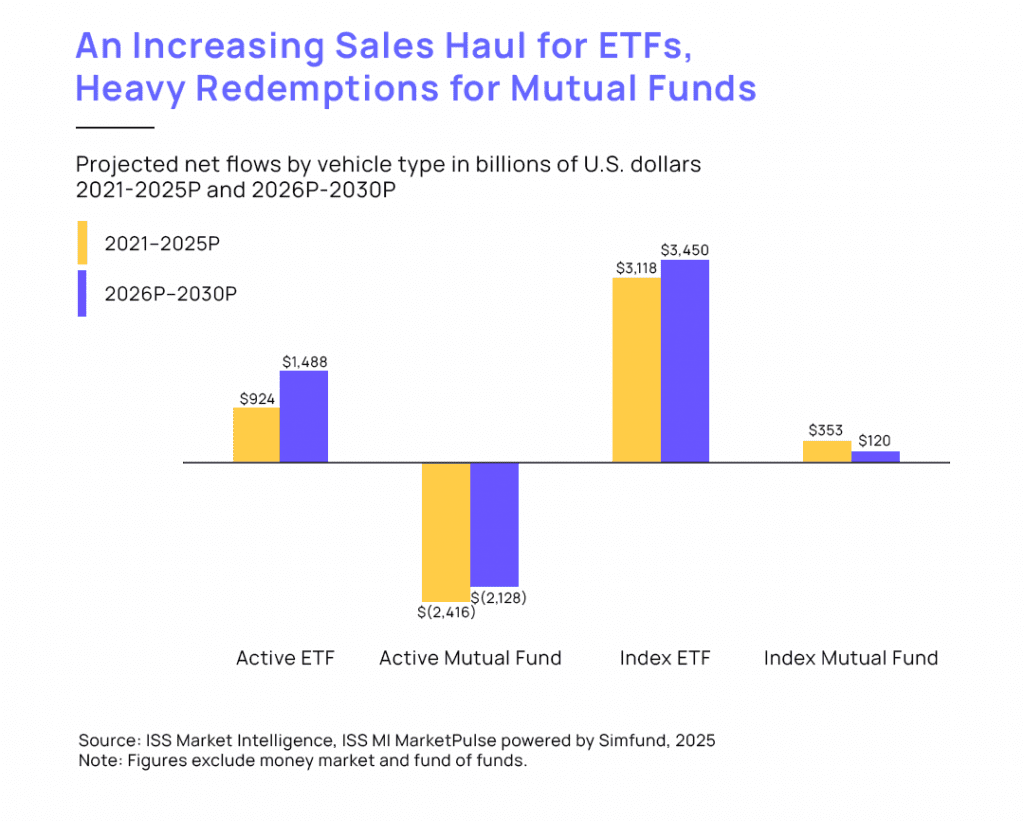
ETFs continue to dominate advisor preferences, with 60% of advisors favoring ETFs over mutual funds or SMAs when given the choice. Active ETFs are accelerating, with record launches this year and over 1,500 products in SEC registration. Semi-liquid vehicles like interval and tender offer funds are also gaining traction, along with innovative solutions such as buffer funds and crypto-linked products.
Active Funds Remain the Industry’s Revenue Backbone
Despite the ongoing migration to passive, active funds still generate the bulk of industry revenue. Managers must balance the need to defend this core business while innovating in areas such as ETFs and alternatives to stay competitive.
In the Product Development Game, to the Victors Go the Spoils
The most successful managers will either:
- Leverage Scale: Large firms can use low fees and portfolio solutions to fund growth in alternatives and private markets.
- Specialize: Focused players can win by delivering unique, high-value solutions aligned with their strongest capabilities.
Those who fail to choose a clear path risk falling into the “mushy middle”—without the scale or specialization needed to thrive.
Section one of this year’s report is now available here to U.S.based MarketSage subscribers. Upcoming additional sections will explore product innovation, including the fast evolving active ETF arena and competing structures, and will examine how partnerships and distribution strategies are reshaping the competitive landscape.
For asset managers, the message is clear: adaptation is essential. Whether through scale, specialization, or innovation, success in the next five years will depend on making bold, strategic choices.