
The ETF boom continues to reshape the investment landscape, but one distribution channel is driving the next phase of growth more than any other. As highlighted in our recent webinar, Winning Strategies for Asset Managers in 2026, registered investment advisers (RIAs) have emerged as the pivotal player in ETF adoption, especially within the fast‑growing active ETF category.
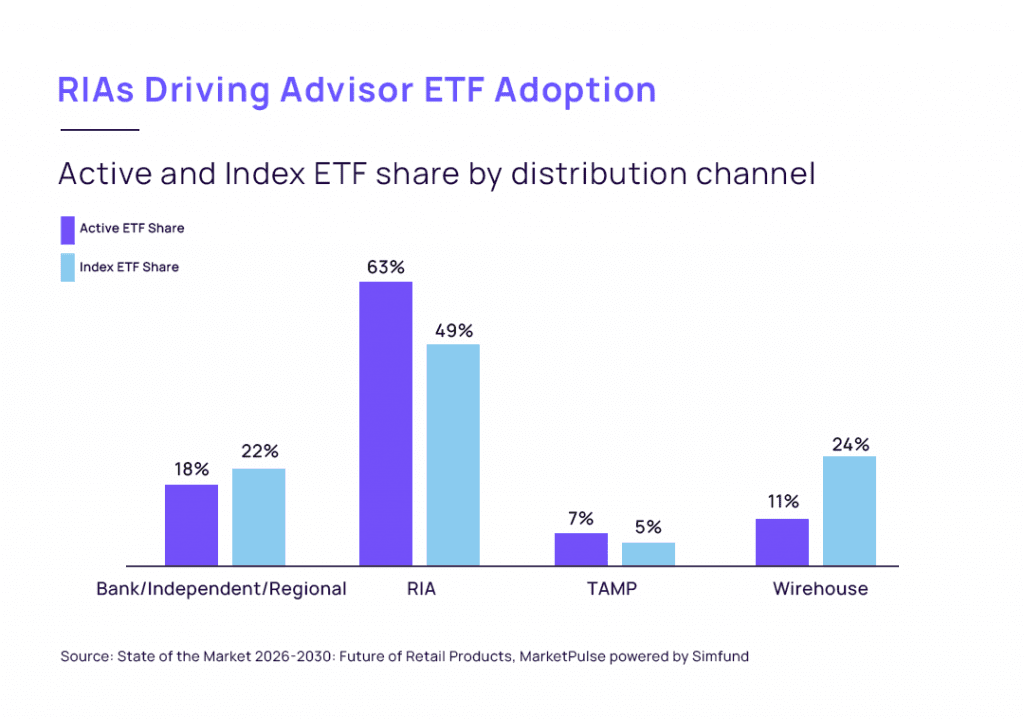
Using 13F filings to analyze long‑term fund demand across distribution channels, ISS MI’s research shows just how outsized the RIA role has become. RIAs account for 63% of active ETF ownership and nearly half of index ETF ownership, far surpassing wirehouses, banks, independent broker‑dealers, and TAMPs. Their influence is reshaping product development, distribution strategy, and competitive positioning for asset managers heading into 2026.
Several forces explain why RIAs sit at the center of this boom.
RIAs Have the Strongest Incentives to Favor ETFs
Across the industry, advisor compensation models have steadily converged toward fee‑based structures. RIAs, however, have operated this way from the start. In a fee‑based model, minimizing investment costs directly benefits both the client and the advisor’s business.
That incentive alignment makes ETFs, with their transparency, tax efficiency, and typically lower fees, a natural fit. RIAs are the most fee‑sensitive buyer group, and the ETF wrapper is built for that mindset. As discussed during the webinar, “form follows incentives,” and RIAs have the clearest incentive structure for ETF adoption.
Different Channels, Different ETF Use Cases
While RIAs are the largest ETF users overall, each distribution channel approaches ETFs differently. Understanding these nuances is essential for asset managers refining their product and go‑to‑market strategy.
- RIAs: Use ETFs as core portfolio building blocks, especially factor‑based equity, core bond, and ultrashort exposures. Their usage is broad, diversified, and tied to long‑term portfolio construction.
- Wirehouses: Lean heavily on index ETFs, while turning to active ETFs for targeted needs such as income generation, option‑based strategies, and hedging. Their preference for active management often shows up in SMAs rather than ETFs.
- Independent broker‑dealers: Focus on packaged trades, including defined outcome ETFs and option‑income strategies. Their ETF usage is more thematic and outcome‑oriented.
- TAMPs: Represent a smaller share of ETF ownership but use ETFs systematically within model portfolios.
Despite these differences, one theme is consistent across channels: advisors overwhelmingly prefer the ETF structure over any other vehicle. That preference signals continued growth ahead, and not just in index ETFs, but increasingly in active strategies as well.
What This Means for Asset Managers in 2026
The implications for product and distribution strategy are clear. RIAs should be a central focus for any manager looking to grow ETF market share. Channel‑specific use cases matter, and product‑channel fit is becoming a critical differentiator as competition intensifies. Firms that align product design with advisor incentives, and understand how each channel deploys ETFs, will be best positioned to capture the next wave of growth.
Insights from this webinar discussion are explored in greater depth in ISS MI’s State of the Market report series, available exclusively to U.S.-based MarketSage subscribers. The latest installment, State of the Market: Recalibrating for the Road Ahead, examines the structural forces shaping asset growth, product demand, and competitive dynamics over the next five years. Both Part One and Part Two of the series are now available on the MarketSage platform for subscribers looking to sharpen their strategic planning for 2026 and beyond.