

The Active ETF marketplace continues its rapid expansion. In 2025 alone, more than 1,100 ETFs launched, including over 900 new active products, marking another record year for innovation and product development. The result is not just a larger market, but a more diverse and complex one.
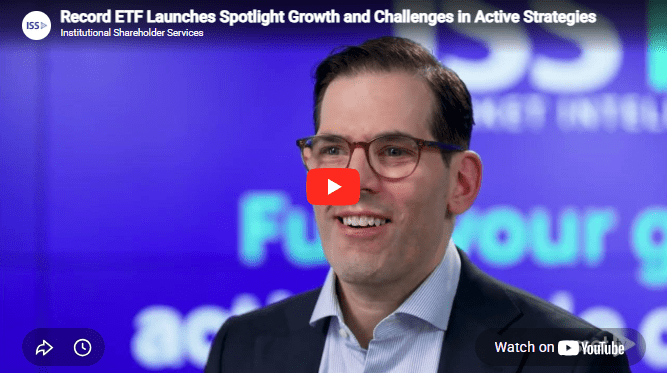
Christopher Davis, U.S. Head of Research at ISS Market Intelligence, joined Asset TV to break down what this evolution means for managers, advisors, and investors. Watch the full segment below and explore the three biggest takeaways.
1. The Active ETF Market Is No Longer One Thing
Active ETFs have grown from a niche to a sprawling ecosystem. There are now more than 2,800 active ETFs, with over 1,000 more in registration. But the label “active” has become increasingly unhelpful.
As Christopher notes in the interview, calling something “active” today doesn’t tell you much. The market now spans three distinct groups:
Alpha‑seeking strategies: Traditional active approaches still dominate, but their share has fallen from 95% at the start of the decade to about 80% today.
Exposure‑based ETFs: These include single‑stock ETFs and other targeted exposures. In 2025, more new single‑stock ETFs launched than diversified stock portfolios.
Outcome‑oriented ETFs: This has been the fastest‑growing segment, driven by a growing investor appetite for buffer funds and volatility‑management strategies. Buffer ETFs alone have grown from nearly zero to roughly 15% of active ETF assets in five years.
This shift reflects a broader trend: investors are looking for solutions, not just benchmark outperformance.
2. Not Every New Fund Will Succeed, But the Winners Win Big
With more than 900 new active ETFs launched last year, not all of them will gain traction. Historically, only 20–30% of new active ETFs reach meaningful scale within three years.
However, the economics explain why product development remains so aggressive. ISS MI research shows that funds that do reach scale earn 10 to 30 times more revenue than those that don’t. The payoff for being a winner is enormous.
Christopher noted that success factors vary by category, and include the following:
Traditional active: long‑term performance, advisor trust, and competitive pricing
Exposure ETFs: speed-to-market, manufacturing efficiency, and precise targeting
Outcome ETFs: differentiated structures that solve real advisor problems, supported by strong distribution
The message is clear: product strategy must match the category you’re competing in.
3. Competition Is Intensifying and Managers Must Prove Their Value
Despite the growth of active ETFs, index products remain the default choice for many investors. To win shelf space and advisor attention, active managers must make a compelling case that their product truly delivers value.
That means you must bring to the table:
- Clear articulation of the problem the product solves\
- Evidence that the strategy works
- Pricing that aligns with the value proposition
- Distribution support that gets the product in front of the right buyers
The bar is rising, and managers must rise with it.
Bottom Line
The Active ETF landscape is expanding, diversifying, and becoming more competitive. For asset managers, the opportunity remains massive, but it isn’t an easy road to success. As Christopher emphasized in this interview, success requires clarity, differentiation, and a deep understanding of the category you’re entering.
Active ETFs are no longer a monolith. They are a marketplace of distinct strategies, structures, and investor use cases. The firms that recognize this shift will be the ones that win the next phase of growth.
For more, read our blog Why Active ETFs Are Among the Fastest‑Growing Segments in Asset Management and What You Need to Know.