
The latest investment trends reach the defined contribution (DC) market more slowly than they do the retail or intermediary markets. Regulators and industry stakeholders have created multiple steps to protect less engaged retirement savers, which can slow the adoption of new strategies and structures. The largest DC plans have served as relative trailblazers through incorporating elements like collective investment trusts (CITs) and auto-enrollment into their plans. While they hold a wide lead in those trends, adoption is gradually moving down market.
The largest DC plans wield immense influence on the overall market. Only 1,092 plans oversaw more than $1 billion in assets at the end of 2023, according to the ISS MI MarketPro Retirement Defined Contribution database. Even as they represented a mere 0.1% of DC plan count, they accounted for nearly a third of all DC participants and controlled over half of DC assets.
The greater resources controlled by the largest plans can be further funneled into delivering greater value for their participants. This may include using scale to negotiate for more favorable options, which is most apparent with CITs. In contrast to mutual funds, CITs can offer customized fee schedules and frequently provide relative discounts to the largest plans in exchange for access to their sizable asset pools. The table below displays the historical share that CITs make up on DC plans, where billion-dollar plans hold a wide lead.
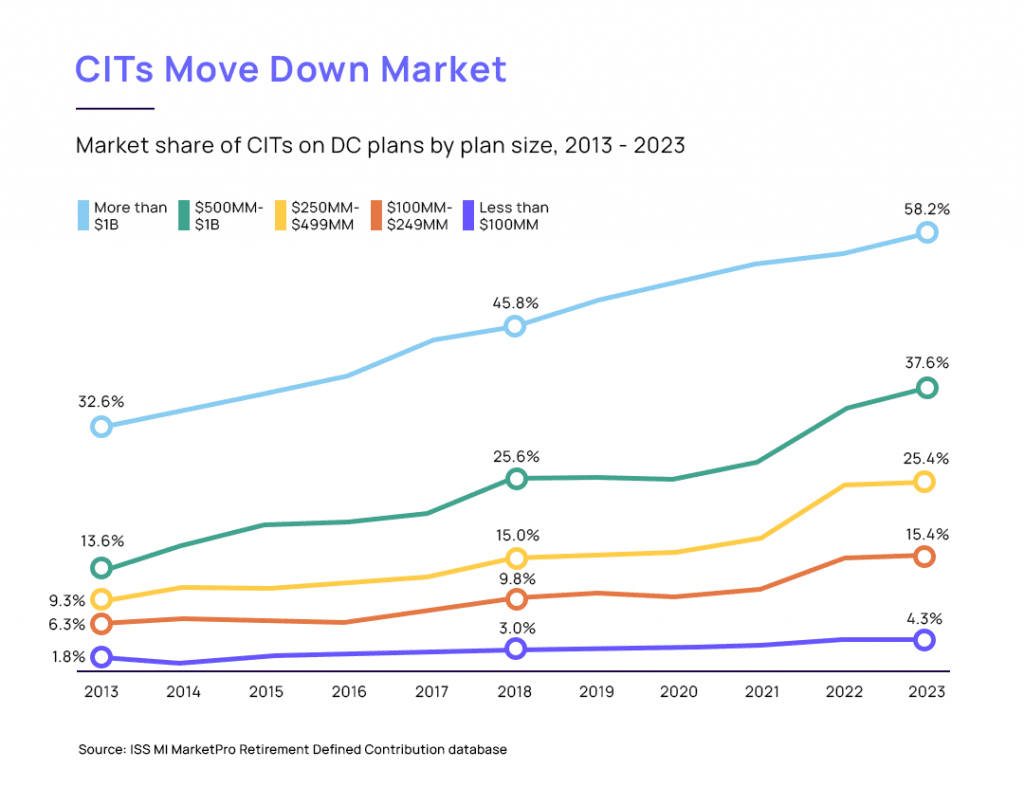
The $2.5 trillion in CIT assets held by billion-dollar plans represented 58.2% of total plan assets as of 2023, a 20-point lead over the share CITs held for plans with assets between $500 million and $1 billion. CIT assets surpassed those of mutual funds on billion-dollar plans as far back as 2011 and grew to account for more than 50% of all billion-dollar plan assets in 2020. The concentration of CITs within large plans provides a foundation for any expansion of alternatives and private markets into DC plans, as the structure is the most likely venue for the incorporation of future alternative strategies. The sizable resources managed by large plans further allow them to engage in the due diligence to evaluate potential alternative options.
While there is a sizable gap between the largest plans and other plan types, the long-term picture shows substantial increases in adoption of CITs across DC plans. The CIT share among plans between $500 billion and $1 billion was higher in 2023 than it was among billion-dollar plans a decade earlier. In fact, this trend repeats throughout the DC market (with the exception of $100 million and smaller plans), as the 2023 share for each lower segment surpassed the 2013 level of the plan size above. The gap in adoptions displays the progress that CITs have made in getting on plans as well as the sizable room they have to expand in the future.
The full report is available to subscribers on the MarketSage research portal. For more information about this report, or any of ISS MI’s research offerings, please contact us.
By Alan Hess, Vice President, U.S. Fund Research, ISS Market Intelligence