

This August will represent the 20th anniversary of the Pension Protection Act (PPA), a landmark piece of legislation with big impacts in shaping the U.S. defined contribution (DC) market. Within the asset management industry, the introduction of the Qualified Default Investment Alternative (QDIA) may well have been the most impactful, providing a safe harbor for certain professionally managed options within DC plans and leading to a significant expansion of target-date funds (TDFs). Since the advent of that market, assets have surged to nearly $5 trillion. That pool has attracted interest from swaths of traditional and non-traditional managers, with 2026 serving as a potential inflection point for the future.
CITs Increasingly the Default
While TDFs first debuted in 1994 through the initiative of Wells Fargo and Barclays Global Investors, the PPA drastically opened up potential distribution. The strategies managed assets of $115 billion in mutual funds at the end of 2006 and crossed $1 trillion by the end of 2017. Ultimately, 90% of all 401(k) plans offer such strategies, according to data from ISS MI MarketPro Retirement, making them the default investments for tens of millions of American investors. The prevalence of auto-enrollment and auto-selection means scores of investors will be enrolled without having to spend extensive time reading over strategy specifics.
With this lucrative opportunity and captive market have come numerous competitors. While the top three TDF managers controlled nearly 75% of assets as of year-end 2025, an additional 19 firms operated TDFs, with a further 37 managers having previously launched and subsequently liquidated theirs. Even as many firms tried to upset the rankings, the greater disruption has come through another vehicle: collective investment trusts (CITs).
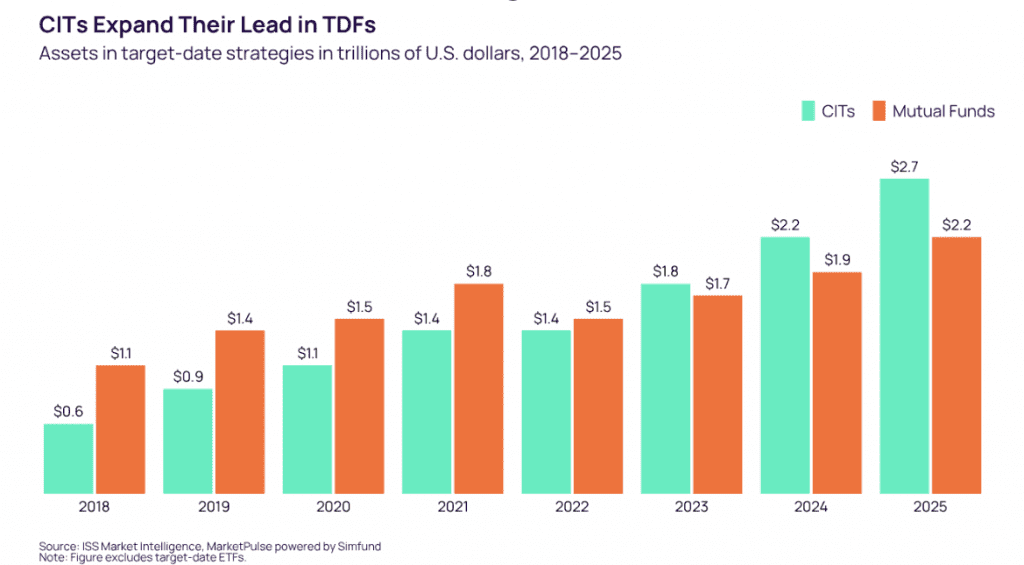
The supreme importance of cost propelled CITs into a leading position, as the structure can offer customized fee schedules. This trend has been most extreme in the top end of the market where large plans can use scale to drive down costs; plans with more than $1 billion in assets had 62% of total plan assets in CITs as of the end of 2023. The exceptional proportion of assets held by the largest plans has allowed CITs to rapidly surpass competing vehicles. Target-date assets in CITs have outpaced those held in mutual funds for over three years, as seen in the table above. The number of managers operating CIT TDFs stood at 45 at year-end, double the total in mutual funds and ETFs. During Q4 2025, CIT TDF assets even surpassed those in all lifecycle mutual funds and ETFs (i.e., including target-date and risk-based funds).
Clearing the Way for Alternatives
CITs are also uniquely positioned to benefit from what may be the largest topic of discussion today in the DC market. The potential introduction of private alternatives into DC plans would most likely come through CITs, thanks to more flexible regulation compared to mutual funds. The regulatory back and forth of the past few years kicked off after a request for clarity around including private equity sleeves within a CIT.
For a further discussion of regulatory developments for private assets in retirement plans as well as a look at advisor sentiment regarding alternatives in DC plans, read the full report, which is now available to subscribers on the MarketSage research portal. For more information about this report, or any of ISS MI’s research offerings, please contact us.
Author:
Alan Hess, Vice President, U.S. Fund Research, ISS Market Intelligence