

At this year’s PLANSPONSOR National Conference, there was no shortage of conversation about how the DC market is evolving. Most of the themes weren’t new. Fee pressure, product innovation, and new plan structures are all well understood.
What stood out more was the inconsistency around where those changes are actually showing up in plans, and where they translate into real commercial opportunity.
This blog pulls together what we heard at PLANSPONSOR, and tests it against what we can see in our data.
The shift isn’t evenly distributed
One point of agreement at PLANSPONSOR was clear: broad exposure to the DC market is no longer enough. Growth increasingly depends on the ability to prioritize with precision, not just expand coverage.
In practice, that means answering a more precise set of questions:
- Where are plans actually changing?
- How do plan changes vary by segment?
- Which advisers, consultants and providers are driving those changes?
- And, most importantly, where does that translate into realistic, near-term opportunity?
Most of the teams we spoke with already have access to vast amounts of data. What they are most often lacking is clarity on how to use it to narrow their focus.
The emergent dominance of CITs
Two structural changes came up repeatedly at the conference: the continued rise of collective investment trusts (CITs), and the acceleration of pooled plan structures. Both are well documented. What matters commercially is how unevenly they are playing out. Figure 1 (below) compares investment vehicle usage in 401(k) plans between 2015 and 2024. Even a cursory glance reveals how far CIT adoption has progressed.
Figure 1: The Evolution of CITs: From Large Plan Dominance to Market-Wide Adoption
Scale advantage drove early adoption, expansion into mid-market creates new opportunity pockets
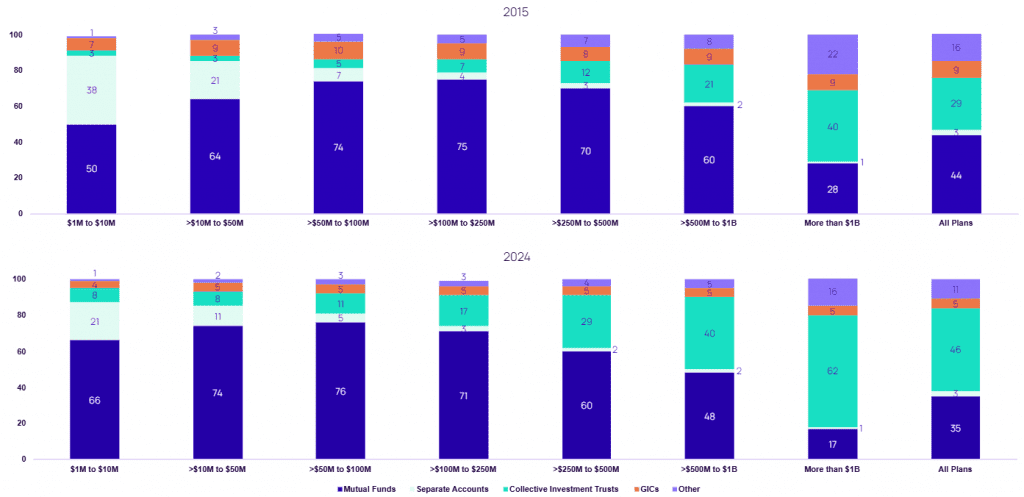
In 2015, mutual funds dominated across every plan size. CITs were gaining ground in larger plans but had limited presence elsewhere. By 2024, that picture had materially shifted.
Across all plans, CITs now represent roughly 46% of assets, up from a much smaller share a decade earlier. In plans over $1bn, they account for more than 60%, overtaking mutual funds decisively. Even in smaller plans (historically slower to move) allocation has increased meaningfully.
CITs are no longer a large-plan story. The expansion into the mid-market and, increasingly, smaller plans suggest a structural change in how DC line-ups are being constructed. Our latest quarterly flow data shows just how quickly assets are consolidating into CITs and other pooled vehicles.
However, this shift is not uniform. Mutual funds still account for the majority of assets in smaller plans, and uptake varies meaningfully by segment, adviser influence and provider relationships.
That unevenness determines where much of the commercial opportunity (and risk) now sits. As we explored in our takeaways from the NAPA 401(k) Summit, platform access alone isn’t enough. Asset flows often lag, and capturing them requires a much more targeted distribution strategy.
Pooled plans move from concept to scale
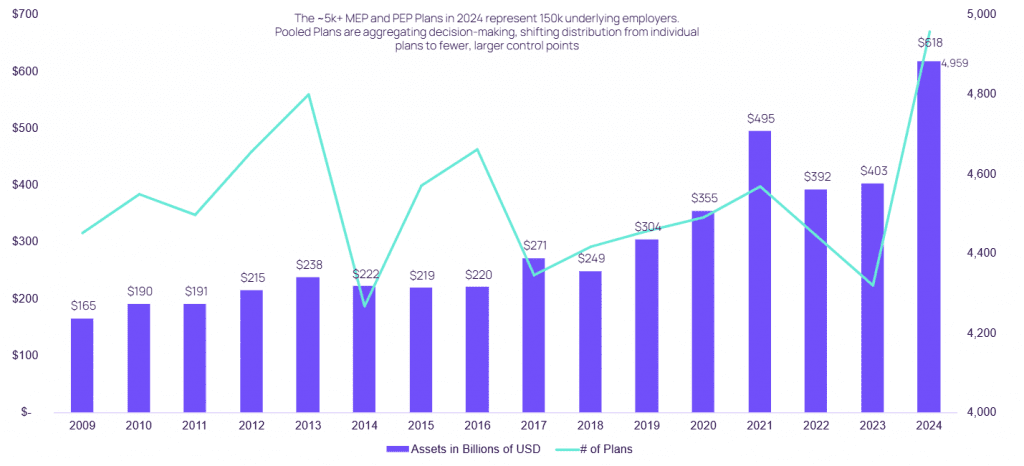
Figure 2 (below) shows pooled plan growth between 2009 and 2024, tells a similar story of acceleration. Again, adoption is not uniform.
Figure 2: Pooled Plans Are Scaling Rapidly, Reshaping How Employers Enter the DC System
Growth in assets is outpacing growth in plan count, indicating increasing scale and consolidation within pooled structures.
A brief reminder of the distinction:
- MEPs (multi-employer plans) have historically brought together related employers, often through associations or shared industries, with a degree of collective oversight.
- PEPs (pooled employer plans), introduced under the SECURE Act, remove the requirement for commonality and shift administrative and fiduciary responsibility to a central provider.
What stands out in the data is the pace of recent growth. By 2024, the pooled plan universe was nearly 5,000 plans, with total assets exceeding $600bn. The trajectory in both plan count and assets has accelerated sharply over the past five years.
Once again, this is not a universal shift. Growth is concentrated among specific pooled plan providers and within certain employer segments. Adoption varies significantly depending on distribution strategy, adviser networks and the underlying economics of the plans themselves.
In the case of both CIT and Pooled Plan adoption, the structural direction is clear. Uncertainty lies within the differences between segments.
Competitive advantage lies in focus
Despite these shifts, many DC growth strategies remain anchored in broad coverage and increasing activity.
That approach is increasingly out of step with how the market is behaving. When change is concentrated, a wide lens inevitably captures a large number of low-probability opportunities alongside the high-value ones. The cost of broad coverage is no longer inefficiency, it’s missed opportunity.
What separates firms that are gaining traction is not simply access to information, but how they use it to prioritize.
In practice, that means being able to identify (with some precision):
- plans that are actively restructuring their investment line-ups,
- segments where shifts in vehicle usage are accelerating,
- advisers and consultants who are consistently influencing those decisions.
Tools like MarketPro Retirement (powered by BrightScope) become critical in this environment, not for providing more data, but for helping teams act on the right data with confidence.
The conversations at PLANSPONSOR reflected a market that is maturing in a particular way. Opportunity in DC is still growing, but it has become far more selective.
Success is no longer driven by broad participation in the market. It’s driven by the ability to:
- identify where structural change is translating into real decisions,
- prioritize those opportunities early,
- and act with conviction.
The firms gaining share are the ones with the clearest view of where to focus. Turn DC market insight into your competitive advantage with MarketPro Retirement.
Author: Viraaj Kumar