
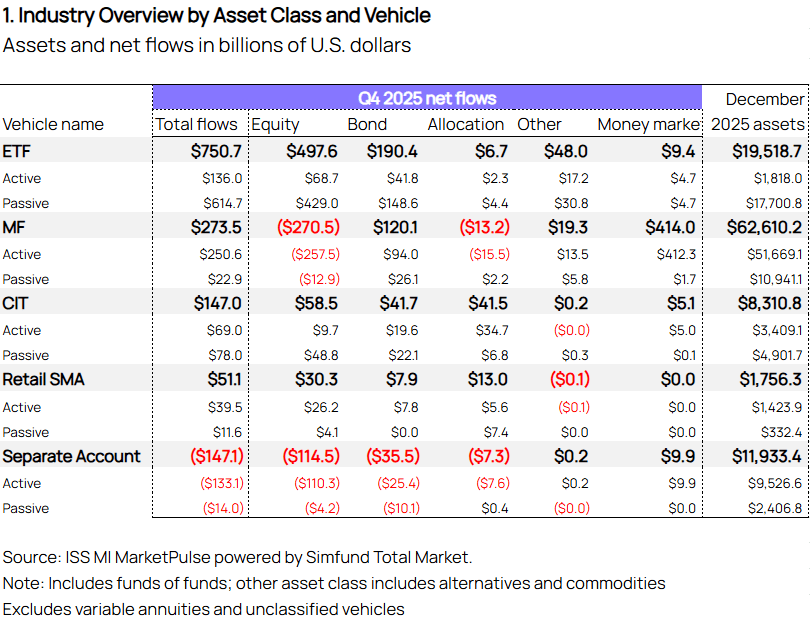
Managed vehicles recorded net inflows of $1.1 trillion in Q4 2025, according to data from ISS MarketPulse powered by Simfund Total Market. This represented a notable increase from the $885.0 billion raised in the third quarter as well as the highest quarterly total in four years. Net deposits for 2025 overall totaled $3.2 trillion, a slight decrease from the $3.4 trillion gathered during 2024.
ETFs
ETFs led net inflows with $750.7 billion in the fourth quarter, a sharp increase from $554.3 billion in the third quarter. Equity ETFs were the main driver of growth, drawing $497.6 billion over the quarter. Passive ETFs dominated overall activity, capturing $614.7 billion in net inflows.
While active ETFs manage a much smaller asset base – $1.8 trillion versus $17.7 trillion for passive strategies – they still attracted a solid $136 billion in new money. U.S.-domiciled ETFs accounted for the majority of inflows across both active and passive funds, with overall flows totaling $520.5 billion. Among passive ETFs, U.S. funds gathered $404.6 billion, followed by $59.7 billion into Ireland-domiciled products. U.S.-based funds held a wider lead within active ETFs, drawing $115.9 billion in net inflows, compared with $5.7 billion for Ireland-based funds.
RELATED: 220 Active ETFs in One Quarter: The New Normal
RELATED: The Advisor Trends Powering ETF Growth and Portfolio Outsourcing
Mutual Funds
Mutual funds recorded the second highest quarterly inflows in the fourth quarter, totaling $273.5 billion, slightly below the $298.4 billion raised in Q3. These inflows continue to be driven largely by money market funds.
When excluding money market funds, long-term mutual funds posted deeper outflows of $144.3 billion, compared with $35.3 billion in the prior quarter.
Bond funds served as a relative bright spot, recording $120 billion in inflows, although this was lower than the $201.4 billion seen in Q3. Equities, by contrast, remained under pressure, suffering withdrawals of $270.5 billion, most of which came from active funds ($257.5 billion). U.S.-based equity funds saw the sharpest losses, with outflows totaling $275 billion for the quarter.
Collective Investment Trusts
Collective investment trusts saw net commitments of $147.0 billion in Q4, up from $94.7 billion in Q3 and the highest since the first quarter ($177.3 billion). Equity funds accounted for the bulk of inflows at $58.5 billion, a significant improvement over Q3’s minor withdrawals ($2.3 billion) and Q2’s moderate outflows ($11 billion). Allocation funds were the second largest contributor, adding $41.5 billion in net commitments, slightly below the $52.9 billion gathered in Q3. All other asset classes also reported positive flows during the quarter.
Separately Managed Accounts
Retail separately managed accounts recorded $51.1 billion in inflows during the quarter, slightly below the $52 billion recorded in Q3. Equity strategies led with $30.3 billion, up from $21.9 billion in the prior quarter. Allocation funds followed with positive inflows of $13 billion after drawing $10.9 billion in Q3. Institutional separate accounts continued to face heavy redemptions, with net withdrawals surging to $147.1 billion, much harsher than Q3’s $114.3 billion. Within this segment, money market funds attracted $9.9 billion in inflows, while equity strategies suffered the most, with severe outflows totaling $114.5 billion.
Mutual Fund Category Trends
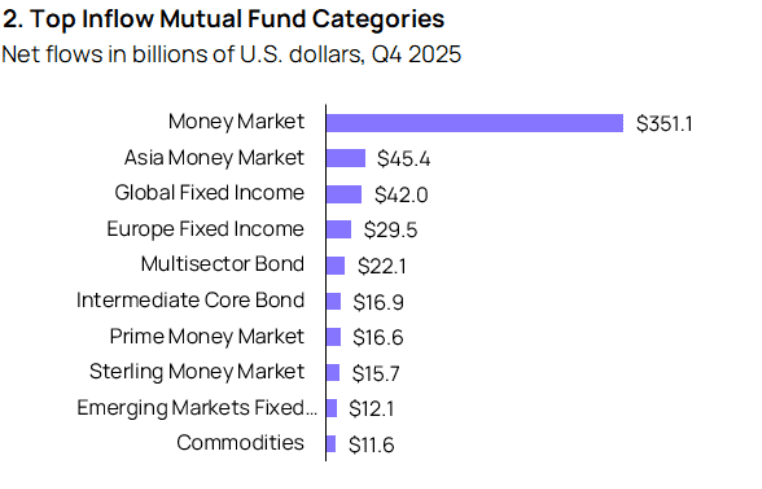
Money market funds were the largest contributor to mutual fund inflows during the fourth quarter by a wide margin. U.S. short-term money market funds led the way, attracting $351.1 billion in net inflows, a sharp increase from $217.6 billion in Q3 and a more than $300 billion lead over the next highest inflow category. Asia money market funds ranked second, posting $45.4 billion in inflows and driven overwhelmingly by China-based funds, though this represented a step down from the strong $62.2 billion collected in the prior quarter. Additional inflows came from U.S.-based prime funds ($16.6 billion) and U.K.-based Sterling money market funds ($15.7 billion).
Fixed income strategies generated the second highest mutual fund inflows in the fourth quarter at $120.1 billion. This did, however, mark a slowdown from the $201.4 billion recorded in Q3.
Demand was strongest in global markets, with Global Fixed Income posting the third largest net commitments for the quarter at $42 billion, down from $54.3 billion in the prior quarter. Ireland-domiciled funds accounted for the largest portion of flows at $15.6 billion, followed by Luxembourg ($9.5 billion). PIMCO emerged as the leading manager in the category overall, attracting $10.4 billion.
Europe Fixed Income also recorded positive inflows of $29.5 billion. Emerging Markets Fixed Income served as another leading international bond category, gathering $12.1 billion in Q4, in line with the $12.4 billion recorded in Q3. PIMCO also led in this category at $2.8 billion, followed by Morgan Stanley ($1.1 billion).
ETF Category Trends
Equity funds remained the dominant driver of ETF inflows in Q4, attracting $497.6 billion, a sharp increase from $315.5 billion in Q3. Gains were broad-based, with large-cap strategies leading the surge.
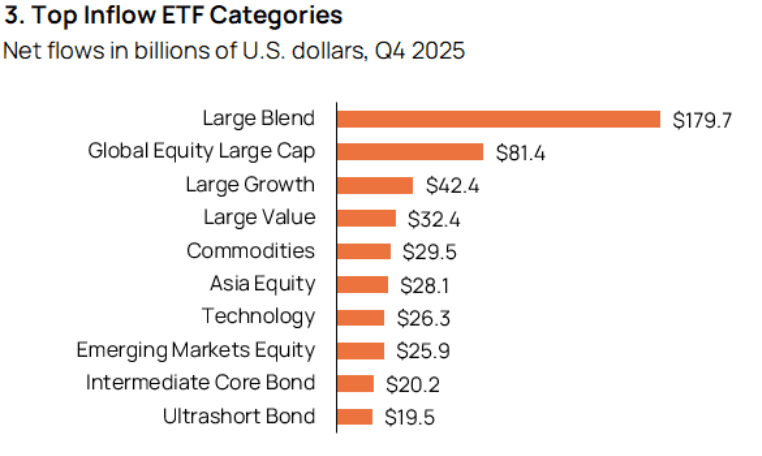
Large Blend funds attracted $179.7 billion in net deposits, well ahead of Global Equity Large Cap at $81.4 billion. Within Large Blend, U.S.-domiciled funds dominated with $160.7 billion in inflows, followed by those based in Ireland ($7.7 billion) and Canada ($5 billion). Global Equity Large Cap also saw inflows edge higher from Q3, supported by U.S.-based funds ($50.2 billion) and Ireland-domiciled funds ($19.4 billion).
Vanguard led both segments, gathering $76.5 billion in Large Blend and $30.2 billion in Global Equity Large Cap, with BlackRock close behind at $51.8 billion and $18.2 billion, respectively.
Other large-cap segments also posted gains, including Large Growth ($42.4 billion) and Large Value ($32.4 billion). Beyond large-cap strategies, Asia Equity ($28.1 billion) and Emerging Markets Equity ($25.9 billion) both attracted positive flows. While Asia Equity predominantly drew flows from funds based in China ($22.2 billion), Emerging Markets Equity flows predominantly came from developed markets, such as the U.S. ($15.2 billion) and Ireland ($6.7 billion).
Other ETF Categories
ETFs continued to support a wide range of investor use cases.
Commodities ETFs gathered net commitments of $29.5 billion in Q4, slightly lower than $30.3 billion in Q3. This was strongest in gold-focused funds, including the SPDR Gold Shares ETF ($7.8 billion), Hua An YiFu Gold ETF ($2.5 billion), and iShares Gold Trust ($1.8 billion).
Fixed income ETFs meanwhile saw increased net deposits, attracting $190.4 billion in Q4 compared to $165.6 billion in Q3. Within the asset class, Intermediate Core Bond funds brought in the most at $20.2 billion, while Ultrashort Bond funds added $19.5 billion. Vanguard gathered the most within Intermediate Core Bond at $10.0 billion, while BlackRock led Ultrashort Bond inflows with $12.1 billion.
Read part two, covering retail SMAs, CITs, and separate accounts.
We’re committed to providing our clients with ongoing insights from this expanded dataset and illustrating how this data enables firms to spot opportunities, analyze fund flows across vehicle types, and conduct customized benchmarking. Contact us here or through a Sales or Client Success representative, and visit our MarketPulse site to learn more.
Authors:
Alan Hess, Vice President, U.S. Fund Research, ISS Market Intelligence
Antara Maity, Senior Associate, U.S. Fund Research, ISS Market Intelligence
Aishwarya Mahalingam, Associate, U.S. Fund Research, ISS Market Intelligence