
How much do model portfolios matter in determining which managers and strategies win assets?
As it turns out, quite a lot.
While no single figure captures their full influence, we can observe their impact through the fingerprints models leave behind. Across advisory channels, we observe firms converging around common ETF building blocks, portfolio structures, and implementation patterns. It is possible that thousands of advisors independently arrived at similar portfolios. But that’s unlikely in an era where home offices, TAMPs, strategists, CIO-directed platforms, and model providers hold increasing sway.
Based on our analysis of 13F holdings disclosure data available on the ISS MI MarketPulse platform, we conservatively estimate that at least $1.8 trillion, or 35%, of the $4.3 trillion in ETF assets held in discretionary accounts at the end of the first quarter exhibited model-like characteristics. This figure, detailed in the latest Windows into Asset Management, includes ETF holdings across wirehouse, broker-dealer, and RIA market segments. Their holdings won’t necessarily reside within a structured model, but they walk and talk like they do.
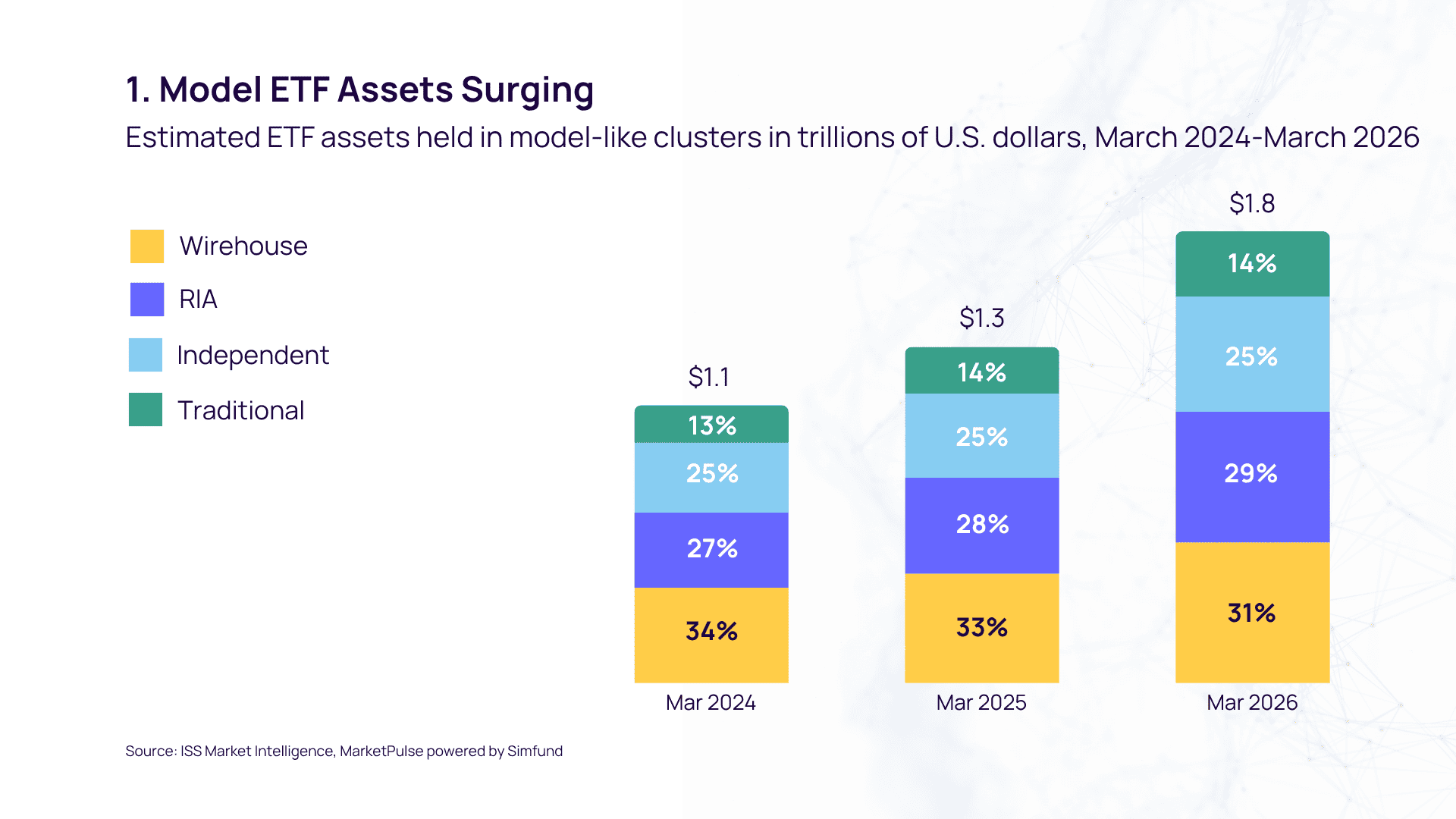
Figure 1 shows model-like assets growing at a rapid clip—up approximately $800 billion over two years—and widely used across distribution channels. This figure surely understates how much they’ve grown; mutual funds and SMAs are widely held in models, but advisors aren’t required to disclose their holdings in the vehicles, the vehicles are excluded from our analysis. However, because ETFs have become the industry’s preferred implementation tool for many portfolio builders, they reveal insights into how and where portfolio decisions are made.
Rather than depicting a single model portfolio market, our research shows distinct market dynamics playing out across channels, each with differing paths to success (see Figure 2).
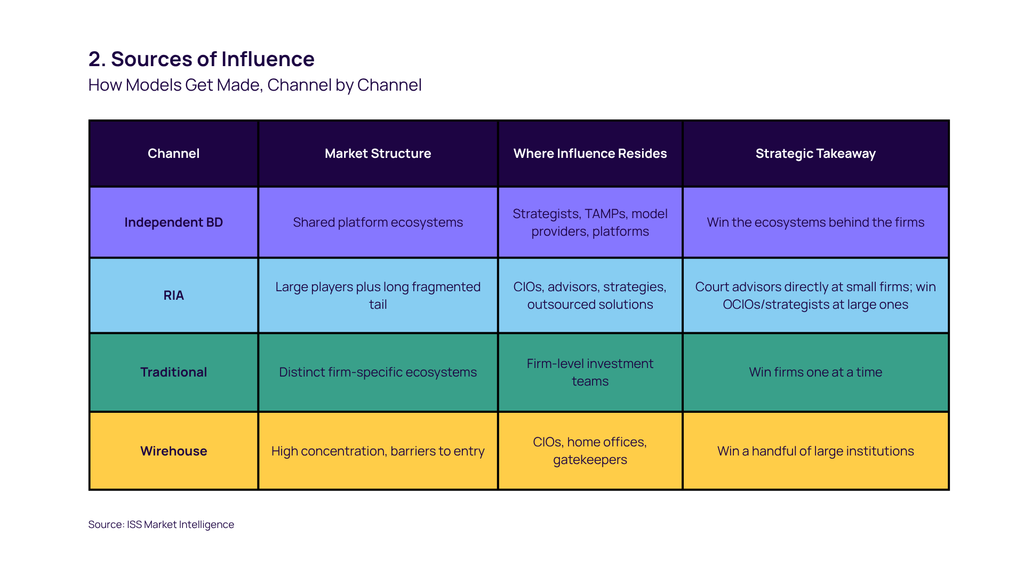
At wirehouses, that path runs through a handful of institutional gatekeepers. Portfolio construction is heavily shaped by CIO-directed frameworks, approved lists, and centralized research processes, resulting in portfolios that look remarkably similar across firms. For asset managers, the appeal is obvious: crack the ecosystem and success can spread quickly across enormous pools of assets.
Traditional broker-dealers offer a similar dynamic, albeit across a larger collection of firm-specific ecosystems. Success often depends on winning firms one at a time, navigating distinct investment teams, approved-list processes, and house views. At independents, by contrast, advisors often choose among shared ecosystems built by strategists, TAMPs, model providers, and portfolio platforms. As a result, managers may gain more leverage by influencing the platforms behind advisory practices than the practices themselves.
RIAs remain the most fragmented channel, reflecting their diversity of business models and investment approaches. Yet even here, scale is gradually shifting portfolio authority toward investment committees, outsourced CIOs, and strategist relationships. Smaller RIAs still operate with considerable autonomy, but increasingly managers must navigate institutionalized approaches to portfolio construction at mid- and large-sized RIAs.
For asset managers, the implications extend beyond distribution. In a model-influenced marketplace, products are evaluated not only on their merits but on how they fit within an existing portfolio architecture. Only a handful of firms possess the scale, breadth, and influence required to define that architecture themselves. Most compete for a place within frameworks designed by others.
Getting on the menu is only part of the challenge. Managers must also understand who writes it. As portfolio authority becomes concentrated among model providers, strategists, investment committees, and research teams, competitive advantage increasingly belongs to firms that know where portfolio decisions are made and how products earn their role within the ecosystem.
See the full report, now available to subscribers on the MarketSage research platform, to learn more about developments in the bond fund market. For more information about this report, or any of ISS MI’s research offerings, please contact us.
Author:
Christopher Davis, U.S. Head of Research
Related: 5 Reasons to Join ISS MI at Future Proof for Happy Hour, Networking, and Monday Night Football
Related: Fund Launches and Liquidations Set to Shatter Old Records