

The product launch boom carried into the first half of 2026. Long-term fund launches reached 836, up from 585 a year earlier and already 63% of full-year 2025 activity. Firms are still launching products at a rapid pace, but activity is increasingly concentrated in specific structures and investment themes.
Active ETFs remained the busiest corner of the launch market, with 620 launches in H1 2026, up from 407 a year earlier and already nearly two-thirds of the full-year 2025 total. The vehicle’s success through strong asset growth, record-setting inflows, and aggressive new launches has attracted new players to the space. Corgi Strategies made the largest splash through the first half of the year with 126 active new ETFs. Single-stock funds continued to play a significant role in new launches, accounting for 188 of the year’s funds and 45 of Corgi’s new offerings. Nonetheless, the scale of adoption and potential use cases extends far beyond any single strategy.
Active ETFs on Path to Surpass 2025 Records
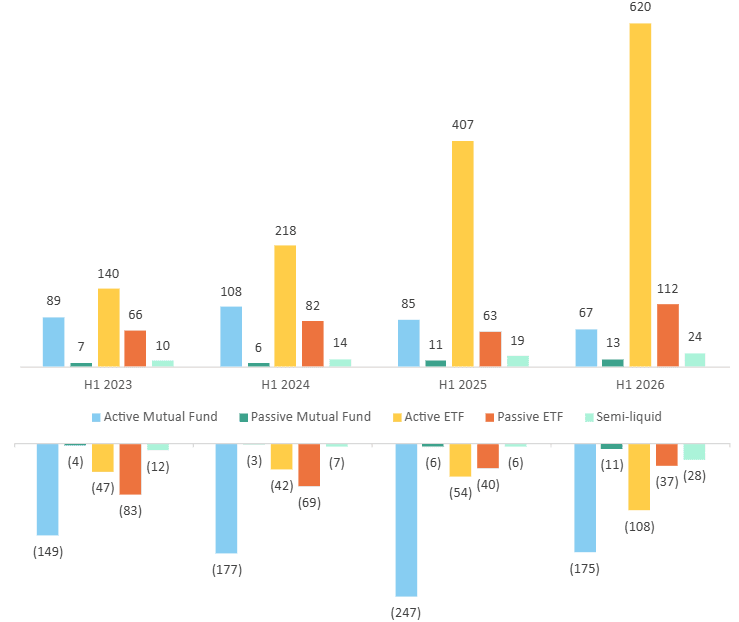
Note: Figure excludes money market funds. Semi-liquid includes closed-end funds, interval funds, and tender offer funds.
The aggressive inceptions have been matched by growing numbers of closures. Liquidations of active ETFs increased to 108 in the first half of the year, double their level from the same period in 2025. While more limited than active mutual fund liquidations, these numbers emphasize that new entrants may struggle to find a sustainable asset base in a crowded market, particularly for those with more constrained mandates.
Artificial intelligence demand fuels product innovation
Recent successes, however, point to the outsized gains that managers can capture by being in the right place at the right time. The Roundhill Memory ETF was a standout example, gathering more than $22 billion in its first quarter, making it the fastest ETF to reach $10 billion in assets thanks to its exposure to high-bandwidth memory stocks tied to the AI supply chain. The artificial intelligence ecosystem has influenced other forms of product innovation, with newly registered funds effectively treating AI computing power as a new commodity.
Beyond the evolving use cases for ETFs, asset managers continue are taking multiple paths to offering them. Since the SEC’s approval of ETF share-class structures, five firms have already launched dual-share structures (which can be tracked using the new “Dual-Shares Fund” flag in ISS MI MarketPulse). Even as this route has opened up for firms, the mutual-fund-to-ETF conversions pipeline has remained robust, with 24 active ETF conversions in H1 2026, up from 15 a year earlier.
Semi-liquid launches persist amidst private credit upsets
On the other end of the spectrum, semi-liquid funds remain a smaller, but still significant, source of new products, even as the structure faces exposure to turmoil within private credit markets. Launches rose to 24 in H1 2026 from 10 in H1 2023, supported by intermediary demand for private market access through evergreen structures. Liquidations and mergers also rose to 28. However, rather than reflecting redemptions pressure on private credit strategies, closure activity in the first half of 2026 came primarily through municipal bond managers reorganizing existing closed-end suites to provide better scale.
Overall, H1 2026 was marked by both expansion and rationalization. New launches accelerated, led overwhelmingly by ETFs, while liquidations and mergers remained elevated throughout the market. Firms continue to bring new ideas to investors, but they are also making tougher decisions about existing product lineups. That combination suggests an industry that remains innovative, yet increasingly disciplined in how it allocates capital and resources across its product lineup.
Talk to us today about how ISS Market Intelligence can help your business.
Authors:
Antara Maity, Senior Associate, U.S. Fund Research, ISS Market Intelligence
Alan Hess, Vice President, U.S. Fund Research, ISS Market Intelligence