

Advisors Embracing New Active ETFs
ETFs are on course to shatter previous records for new launches in 2026, serving as the primary source of product development in the registered fund space. This has included both esoteric funds with narrow mandates as well as scores of traditional strategies. Bringing strategies to market is only the first step for asset managers seeking to expand their footprint in the structure; ensuring they are selected by investors is another. The adoption of new strategies within intermediary channels has ultimately diverged dramatically between active and passive ETFs. While new active ETFs have recorded faster growth than older products, interest in passive ETFs is overwhelmingly captured by legacy funds incepted 20 years ago. Within active ETFs, advisors have demonstrated strong demand for core positions as those strategies are under pressure for mutual funds.
Active interest concentrated in new funds
Intermediary advisors have been central to the growing role of ETFs. ISS MI’s Advisor Pulse reports on portfolio construction and vehicle preferences have covered how advisors increasingly prefer ETFs to other vehicles, frequently choosing them for their cost savings and tax efficiency. RIAs have acted as the lead adopters of ETFs; 2025’s report found that 78% of RIA advisors most preferred strategies from their leading asset managers in the form of ETFs, well ahead of all other channels. Data on intermediary holdings from ISS MI MarketPulse, recently enhanced through new channel breakouts and explored in the latest issue Windows into Asset Management, reinforces the extent of that adoption. MarketPulse’s 13F data captured $1.6 trillion in active ETF and $4.3 trillion in passive ETF assets across RIA, broker-dealer, and wirehouse channels as of March 2026, representing 50% of the active market and 39% for passive ETFs.
RIAs led in total assets across both active ($442.7 billion) and passive ETFs ($1.7 trillion). Their active ETF holdings in fact surpassed the combined assets from traditional and independent broker-dealers as well as wirehouses. The aggressive interest that RIAs have demonstrated for the vehicle is even more intense when observing growth by fund vintage. Active funds launched since the beginning of 2023 recorded greater growth over the year between March 2025 and March 2026 than the entirety of funds launched prior to 2020, as seen in Figure 1.
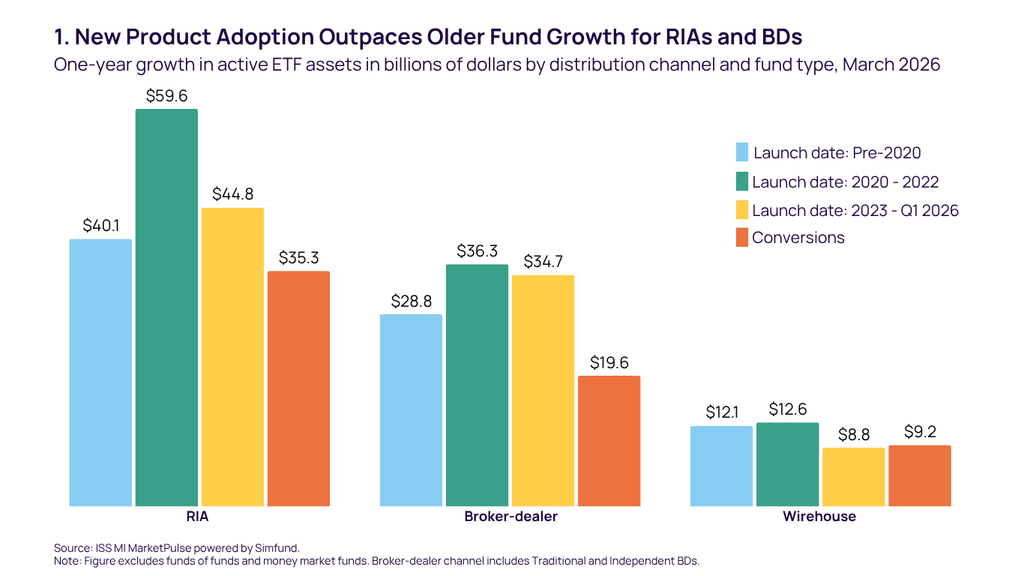
Traditional and independent broker-dealers saw a similar, but lower scale, adoption of new active ETFs, as funds with new vintages also witnessed stronger growth than pre-2020 funds. Demand within wirehouses was, conversely, the most muted. Newer funds recorded comparable increases as older vintages, but the tighter control that home offices and their due diligence teams exercise over wirehouse platforms has led to lower overall levels of growth across the board. The higher standards for new strategies mean that smaller and more unconventional funds will have the most difficult time finding shelf space in the channel.
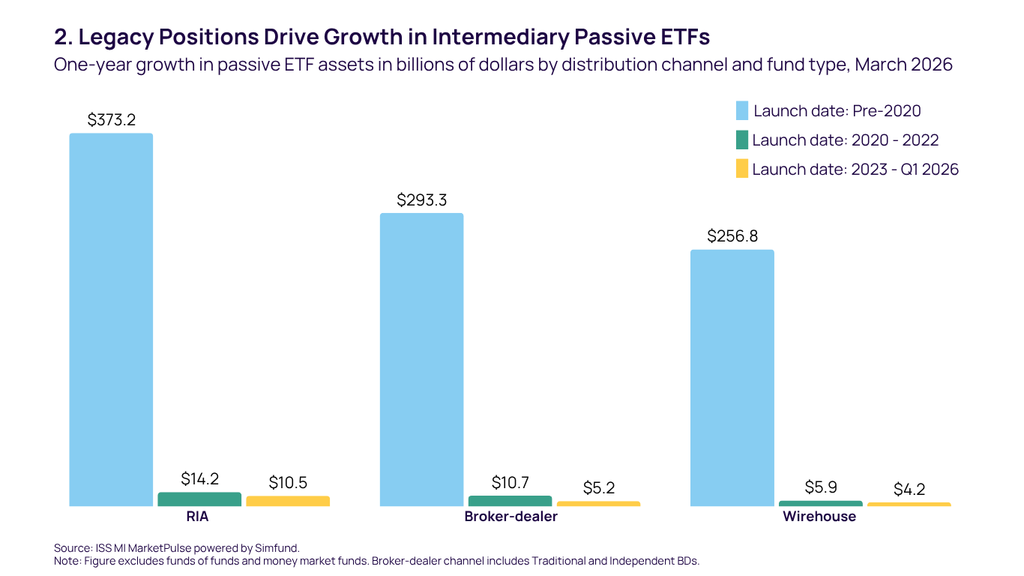
Passive ETFs recorded quite a different trajectory within intermediary channels. RIAs continued as the leading adopter, but with a smaller lead than seen among active ETFs; as of March 2026, RIAs held $1.6 trillion in index ETFs compared to just under $1.3 trillion for each of the broker-dealer and wirehouse channels. Growth, meanwhile, in passive ETFs was concentrated overwhelmingly in older funds as seen in Figure 2, particularly in funds launched between 2000 and 2007 at the market’s outset.
See the full report, now available to subscribers on the MarketSage research platform, to learn more about intermediary adoption of new products as well as the use of ETFs in model portfolios. For more information about this report, or any of ISS MI’s research offerings, please contact us.
Author:
Alan Hess, Vice President, U.S. Fund Research
Related: Who Really Decides Which ETFs Win? The Rise of Model Portfolios