

The retirement savings landscape in the United States is dominated by employer-based defined contribution (DC) plans. Those plans, however, come with direct costs and potential liabilities for employers, leading to a retirement access gap within the United States. To lessen the burden on individual employers, regulators have created frameworks for multiple employer plans (MEPs), allowing groups of smaller employers to band together and pool resources and assets. The introduction of pooled employer plans (PEPs) created a structure with fewer restrictions than MEPs, but the established MEP market leaves them with a sizeable, if not quite insurmountable, lead.
Closing the access gap
Even as workers frequently view retirement plans as a leading benefit, gaps in availability and participation mean that just slightly more than half of private sector workers invest in their employer-based DC plans. Lack of access stands out even more strongly among smaller firms, with private-sector firms below 50 employees recording closer to a 39% participation rate.
Multiple employer plans date back to the passing of the Employee Retirement Income Security Act of 1974 (ERISA) that served as the foundation for today’s 401(k)-dominated landscape. Certain hurdles ultimately slowed their long-term development. MEPs require a common bond between employers, such as a shared industry, and historically featured a “unified plan rule” that could lead to the disqualified of an entire MEP if individual employers failed to meet requirements. Assets in MEPs as of the end of 2024 totaled $487.7 billion, which represented around 5% of assets in ERISA-compliant DC plans, according to figures from ISS MI MarketPro Retirement.
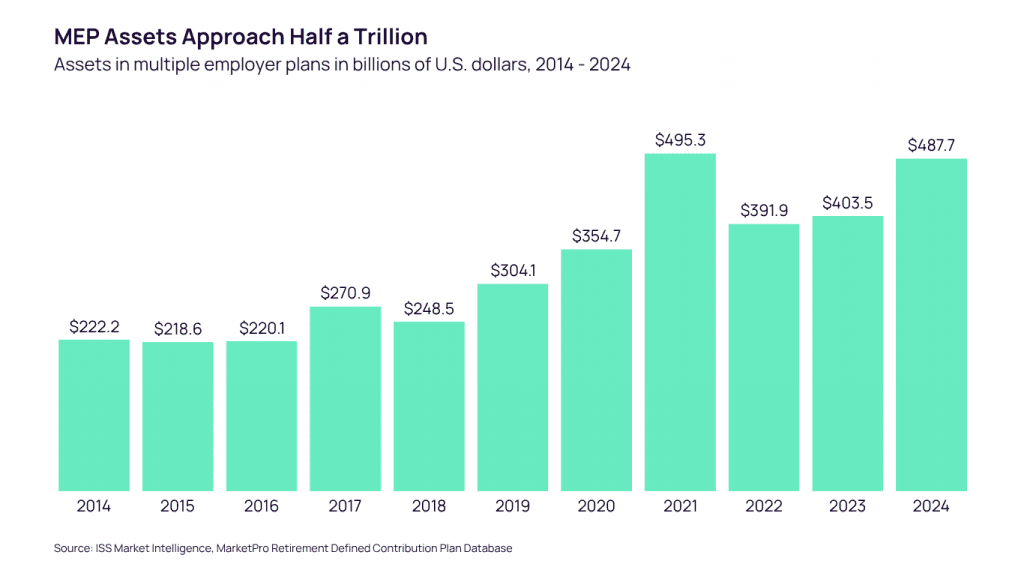
In the SECURE Act of 2019, Congress introduced a much more streamlined structure in the form of Pooled Employer Plans, eliminating the need for a common bond between employers and addressing the unified plan rule. While PEPs present clear improvements for employers seeking to offer retirement benefits, the MEP market’s longer history leaves it more firmly entrenched. In fact, the years since the passing of the SECURE Act have witnessed assets in MEPs pick up significantly. Assets effectively doubled between 2018 and 2021 before facing the same pressure as the DC market overall following the Fed’s aggressive rate raising campaign.
While PEPs stand to attract a greater number of new savers in the coming years, MEPs also benefited from the changes in legislation that created PEPs. Regulators took further steps to update the unified plan rule within MEPs, issuing new rules allowing firms to take steps to address out-of-step firms or serve them from the plan.
For a further discussion of leading multi-employer plans and future demand opportunities for MEPs and PEPs, read the full report, which is now available to subscribers on the MarketSage research portal. For more information about this report, or any of ISS MI’s research offerings, please contact us.
Author:
Alan Hess, Vice President, U.S. Fund Research, ISS Market Intelligence