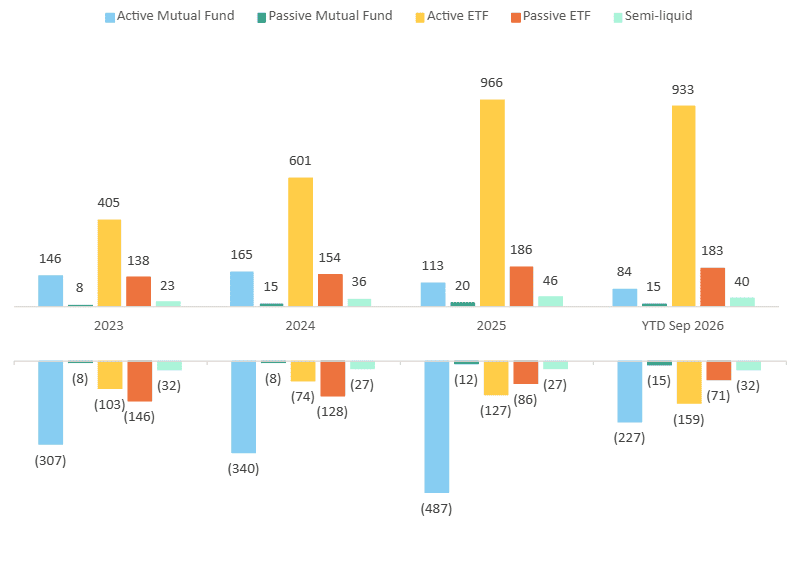
The fund industry’s product-development boom showed little sign of slowing through the first nine months of 2026. Long-term fund launches reached 1,255, already equivalent to 94% of the 1,331 products launched during all of 2025. Active ETFs (933) remained the clear center of this activity, nearly matching last year’s total of 966 and accounting for 74% of all launches. Even as managers released active ETFs across asset classes and styles, certain players and approaches played an outsized role in new issuances. Corgi Strategies launched 197 active ETFs year-to-date, while 290 single-stock active ETFs came to market through September.
Amid the sheer scale of launches, specific funds tied to industry-dominating themes have recorded outsized gains. The Roundhill Memory ETF experienced the fastest growth of a new fund in industry history due to targeted exposure to global memory-chip companies associated with the AI buildout. The Tema Space Innovators ETF meanwhile crossed $1 billion from combining public space companies with access to privately held SpaceX.
Active ETFs Define 2026 Inceptions
Source: ISS MarketPulse powered by Simfund
Only a fraction of funds launched in this environment will reap such benefits. The aggressive launch activity in 2026 was in fact accompanied by rising closures. Active ETF liquidations and mergers reached 159 through September, already above the 127 recorded during all of 2025. With nearly 1,000 active ETFs introduced last year and in the first nine months of 2026, pressure will increase on existing products to deliver performance and asset growth or shutter. The growth of single-stock and other narrowly focused funds has seen managers launch large series of funds with the understanding that a small number will reach scale. Of the 159 active ETFs closed in 2026, nearly half (77) were single-stock funds.
Mutual fund consolidation easing
The landscape for mutual funds stands in stark contrast to ETF developments. Active mutual fund launches reached 84, while liquidations and mergers totaled 227. Though higher than other vehicles, it was also less than half the 487 recorded in 2025. Both new launches and product turnover are increasingly shifting toward ETFs, though developments through 2026 also point to a blurring of boundaries between the two structures.
Since the Securities and Exchange Commission (SEC) began approving the addition of ETF share classes for existing mutual funds, five firms have launched dual-share structures, identifiable through the “Dual-Shares Fund” flag in ISS MI MarketPulse. Dimensional Fund Advisors plans to extend the structure across eight additional strategies representing approximately $250 billion in assets, pioneering dual-shares use after having led the mutual-fund-to-ETF conversion approach.
Semi-liquid funds expand selectively
Semi-liquid funds, including closed-end funds, interval funds, and tender offer funds, remained another active area of the market, with 40 launches through September, approaching the 46 introduced during all of 2025. Even as strategies like private credit experience cooling demand, managers continue to explore ways to offer access to private assets. 32 semi-liquid products were ultimately liquidated or merged in 2026, exceeding the 2025 total and concentrated in a series of municipal bond closed-end funds.
Offering greater exposure to alternatives is a key goal of both asset managers and regulators. In September, the SEC proposed modernizing the interval fund framework, including greater flexibility around repurchase schedules and a rules-based path for regulated closed-end funds to offer multiple share classes. Such changes could accelerate the development of semi-liquid products through making them easier to structure and distribute.
Looking ahead, dual-share structures could give managers another way to extend established strategies into the ETF market, while proposed interval fund reforms may create more flexibility around private market offerings. Combined with the success of highly targeted launches, these developments suggest that the next phase of growth will be shaped not just by what managers launch, but by how flexibly they can deliver their investment capabilities.
Talk to us today about how ISS Market Intelligence can help your business.
Authors:
Antara Maity, Senior Associate, U.S. Fund Research, ISS Market Intelligence
Alan Hess, Vice President, U.S. Fund Research, ISS Market Intelligence