

Exchange-traded funds (ETFs) have continued driving structural transformations across the asset management industry. The repeated sales success of passive ETFs has encouraged asset managers to apply the vehicle’s advantages to their actively-managed strategies. Lower fees and tax efficiency can provide critical benefits on the margin considering the increasingly cost-competitive market.
Active ETFs have served as the primary vector for new active demand and new product development. The vehicle has already hit multiple milestones this year; not only did active ETFs cross $1 trillion in assets in May, but September saw them set records for both monthly inflows and for new launches in the year-to-date period.
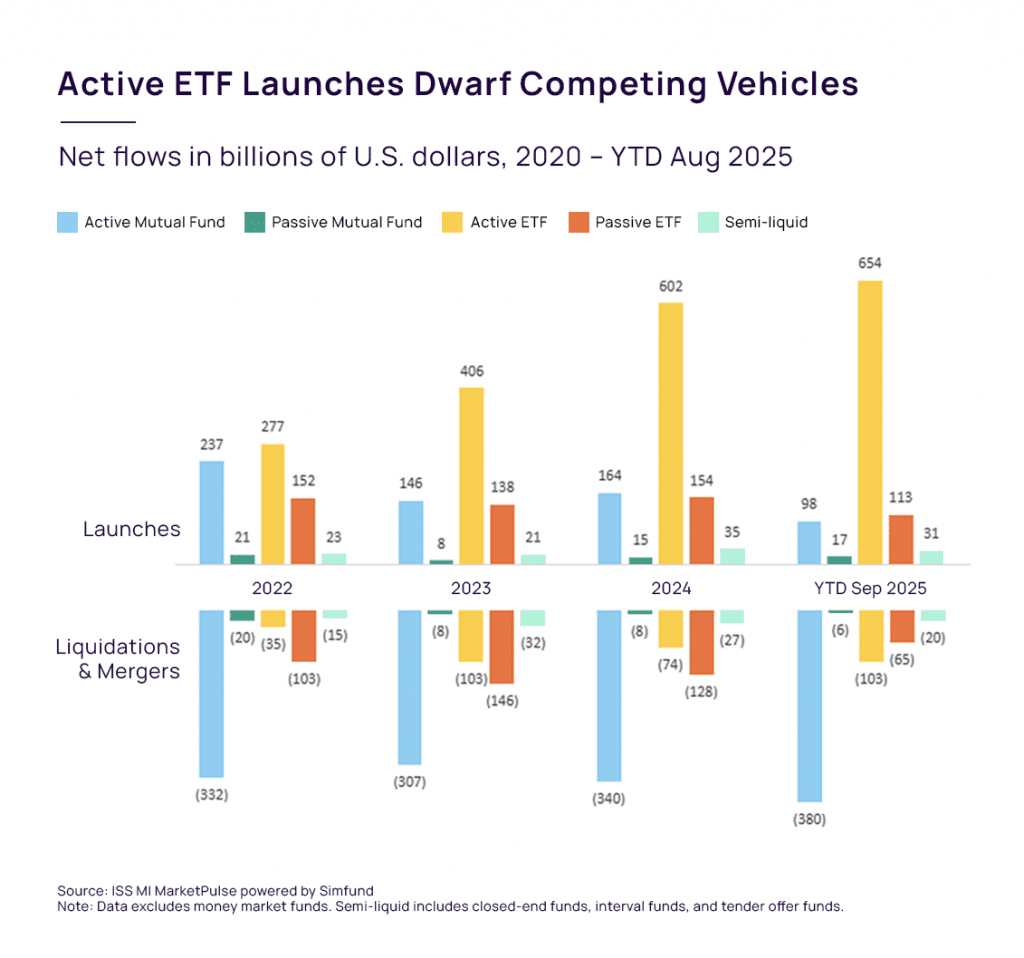
As we approach the end of the year, active ETFs have already surpassed the previous record of new fund launches set during 2024 (602). The influx of funds with more narrow mandates undoubtedly played a key role in setting this record. This year has so far seen the addition of 197 single-stock funds and 72 defined outcome funds. (Click here for recent research from ISS MI on leading intermediary adopters of defined outcome ETFs.) Still, even absent these funds, active ETFs held a more than 200-fund lead in new products over the next highest vehicle in the YTD 2025 period. Managers have flocked to the structure across equity, fixed income, and alternative asset classes.
Not every fund launched will see success. Constrained shelf space at distributors and limited track records for new products can make it harder for any individual fund to reach scale. In addition to record-setting new launches, so far this year we have seen active ETF liquidations and mergers outpace those of passive ETFs for the first time in industry history. Fortunately, even sectors that are prone to higher liquidations can gather substantial assets, with single-stock funds managing nearly $43 billion in assets and defined outcome funds managing more than $70 billion as of September.
With revenue from active funds critical for industry profitability and ETFs driving new active demand, active ETFs look set to remain in the industry spotlight for years to come. The long-awaited approval of ETF share classes points to yet more open ground for their expansion. While asset managers have been eager to launch new active ETFs to capture growing investor interest, widespread adoption of ETF share classes could prove more appealing to many asset managers than launching a new standalone fund. The ability to benefit from existing track records and economies of scale will, however, have to compete with new operational and regulatory challenges.
Regardless of the form it takes, active ETFs are likely to remain an engine of product development.
Talk to us today about how ISS Market Intelligence can help your business.
By Alan Hess, Vice President, U.S. Fund Research, ISS Market Intelligence