

RIA Aggregators Redrawing the Wealth Management Map
The increased appeal of independence has led to tremendous success and growth for the registered investment advisor (RIA) channel as well as a more complicated distribution landscape. Advisors continue to leave large, centralized wealth managers for RIAs, spreading talent and assets across thousands of smaller firms. In response, RIA aggregators are increasingly bringing many of those firms together through acquisitions and strategic affiliations. These organizations take on a variety of forms, from connecting advisors on a shared platform to reorganizing them into fully centralized enterprises. Aggregators are not only redefining what independence means in the RIA channel, but also how asset managers engage with them.
Independence creates aggregator opportunity
Improvements in technology and available solutions have driven financial advisors to place a greater importance on independence. ISS MI’s Rep Movement Report has covered how the independent broker-dealer and RIA channels capture nearly all net movement of licensed representatives across distribution channels, attracted by the greater control advisors have over payouts, platforms, and products. During the five-year period between 2021 and 2025, retail-focused RIAs attracted 9,525 reps from other channels, while independent broker-dealers brought in 5,780. Movement to the RIA channel has resulted in a spread-out market, as nearly 35,000 firms in that channel, effectively 85% of the total firm count, employ five or fewer representatives. Given the dispersion of locations and the differing investment approaches taken by each firm, this presents challenges for coverage strategy of asset managers and how they seek to support advisors in this market.
This fracturing trend affects not only asset managers looking to sell their products but also incumbent wealth managers employing advisors. Larger, established, and centralized firms are losing experienced advisors to independent outlets while experiencing a demographic crunch; the graying of the advisor workforce has coincided with difficulties in recruiting and training younger advisors. Against this backdrop, RIA aggregators have stepped into market, uniting disparate firms. Just as the RIA market contains a myriad number of firms, aggregators have taken a variety of approaches in knitting them together. The table below displays definitions and examples from ISS MI’s classification of aggregators, included in the latest issue of Windows into Wealth Management.
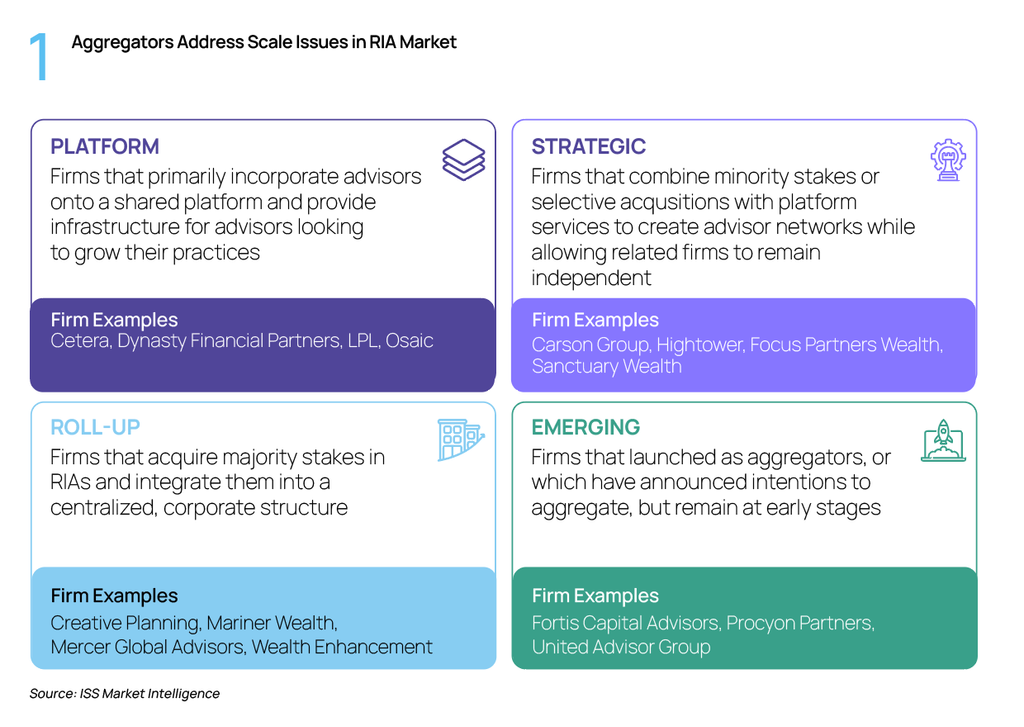
Platform aggregators, including firms like Dynasty Financial Partners, primarily interact with RIAs through onboarding them onto the company’s broader platform while allowing firms to retain their own branding and overall control. Strategic aggregators like Hightower invest widely through a series of selective acquisitions or minority stakes in companies. Conversely, roll-up aggregators such as Mariner Wealth will pursue majority stakes with the goal of combining companies into one cohesive outfit. Beyond established firms with multiple years of acquisitions under their belts, emerging aggregators have staked out plans to aggressively purchase other firms yet remain at early stages themselves.
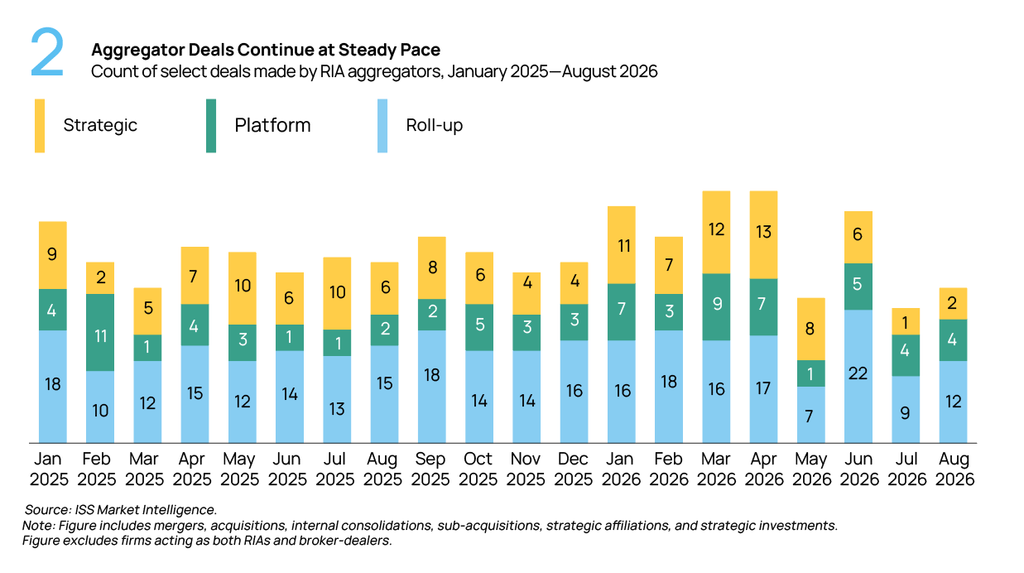
These classifications group firms by their primary interactions with RIAs, but the scale of activity in the market means aggregators are not limited to simply one approach, with firms unveiling new divisions that act more like roll-up aggregators, such as Hightower’s Signature Wealth. Acquisitions have been robust across different types of aggregators, though roll-up aggregators have been most proactive when focusing on firms acting solely as RIAs.
Related: Who Really Decides Which ETFs Win? The Rise of Model Portfolios
See the full report, now available to subscribers on the MarketSage research platform, to learn more about converging models within the RIA aggregator space as well as shifting investment opportunities for asset managers. For more information about this report, or any of ISS MI’s research offerings, please contact us.
Authors:
Alan Hess, Vice President, U.S. Fund Research, ISS Market Intelligence
Antara Maity, Senior Associate, U.S. Fund Research, ISS Market Intelligence
Aishwarya Mahalingam, Associate, U.S. Fund Research, ISS Market Intelligence